


RESISTING THREATS
WHO TAKES ACTION?
Where democracy is threatened by anti-democratic governments, we see institutions, individuals and communities are taking action. From judges to mayors, scholars to florists, public servants to punk bands, anyone can help to resist threats.
-
Resistance can take many forms, including official action to stop or slow down anti-democratic measures (e.g. court judgments), political action to oppose measures (e.g. in the legislature), or broader expressive action such as protests and campaigns. Resistance is always a mix of the practical and the symbolic. Beyond the concrete measures they take to undermine democracy, one of the most powerful features of many anti-democratic governments is their ability to construct narratives. Resistance also depends on constructing counter-narratives as well as taking practical and technical action.
-
The possibilities and parameters for resistance against authoritarian encroachment by a range of actors across society will be shaped by a variety of factors, including:
The structure of the state and political institutions - more diffuse power may present more potential sites of active resistance;
The independence of state institutions;
The culture of institutional actors, including whether they see guardianship of the democratic system (and the rule of law) as part of their role;
Existing freedoms of speech and association; and
A culture and practice of protest.
-
Resistance against authoritarian takeover in a previously functional democracy - whether it is subtle or more overt - will always be time-sensitive. Experiences in states such as Poland, Slovakia or India have shown how quickly a democratic system can be captured by an authoritarian or illiberal leader/government. With each institution that is taken over or diminished in power, more pressure is placed on the remaining institutions - and the wider society - to hold the line and push back.
-
The short answer is no. While concerted action by state institutions such as the legislature, courts, and independent electoral, integrity and human rights agencies can act as ‘speed bumps’, they cannot withstand authoritarian takeover without strong and coordinated civil society and public action.
-
Even in a broadly functioning constitutional democracy tensions exist regarding the limits on the power of elected governments. Unelected institutions (e.g. courts) charged with ensuring the government respects the Constitution, the limits on its own powers, and individual rights are always in a difficult position. These tensions become more acute where an elected government acts in authoritarian manner, but the importance of guardrails also becomes more acute. Unelected actors engaged in resistance are often faced with the challenge o staying true to the Constitution while finding creative ways to rein in the government.
-
Resistance against a government seeking to subvert the democratic system can be partisan, principled or (more usually) a mixture. The common trick of budding autocrats is to portray all opposition and resistance as merely base partisanship, even (or especially) when it is rooted in principle and the law.
-
Some examples of resistance are provided below, and include:
The resistance by the South Korean Congress, political parties, citizens and the military against President Yoon’s declaration of martial law in December 2024;
The party-political and civil society opposition resistance to anti-democratic governments in Poland and India;
Congress and courts’ reaction to attempted electoral subversion and an attempted coup d'état in Brazil in 2022;
Public servants’ resistance to extreme measures under the first Trump presidency in the USA.
key actors

POLITICAL PARTIES
Political parties committed to democracy are a central force to resist authoritarian advances. This includes not just the opposition in the main legislature, but also at times the ruling party, city mayors, and - in federal systems - state governors and legislators.

GUARANTOR BODIES
Guarantor or ‘fourth branch’ bodies, such as independent electoral, human rights, and integrity agencies can play a significant part in challenging, impeding or at least slowing authoritarian advances.

CIVIL SOCIETY
A host of civil society actors play important roles, including: the media, lawyers and bar associations; human rights and democracy non-governmental associations (NGOs); academics; and the cultural sphere.

judges
Judges are a key bulwark against any government project to dismantle constraints on its power. This includes apex courts but extends far beyond adjudication to include action off the bench (e.g. speeches to parliament, reports by judicial associations, protests).

PUBLIC SERVANTS
Public servants can counter neo-authoritarian pressures. ‘Civil service disobedience’ (as opposed to civil disobedience) takes many forms and must be handled carefully.

INTERNATIONAL ACTORS
International actors that commonly play a role in resistance include: foreign governments; international and regional organisations; international courts; and transnational pro-democracy movements.

THE PUBLIC
It should go without saying that the public are the most important source of resistance to anti-democratic governments. Certainly, they can make themselves heard through elections, media channels, protest and other means. In many states, people power has been crucial to turning the tide. However, issues like constitutional literacy and hyper-polarisation mean that citizen action is complex. It is also notable that, as well as undermining democracy in many ways, social media has become a key tool for citizens to come together and organise leaderless rallies, which have become more common.
GET THE FULL PICTURE
watch - is judicial resistance justified?
Should judges remain silent in the face of political encroachment and trust in institutional safeguards? Or must they step outside the courtroom, resisting through activism, media engagement, and transnational alliances? If they do, how can they resist unprecedented interferences, political and public, in the independence of their decision-making? Watch this discussion from 7 May 2026 with Demoptimism Director Tomás Daly, Lisa Hilbink, Agnieszka Kubal and Katarína Šipulová, hosted by Oxford Global Society.

WATCH - can courts save democracy?
Can courts save democracy? In this discussion organised by the Center for Constitutional Design (Arizona State University) and the Phoenix Committee on Foreign Relations three experts - Jeffrey Staton, Larry Diamond, and Demoptimism Director Tom Daly - discuss what judges have done worldwide.

Pushback Against Martial Law in South Korea
The strong pushback by political parties, institutions and citizens against President Yoon’s attempt to impose martial law in December 2024 deserves global attention. Access our InfoHub below.

What Makes a Political Opposition Effective?
Given the strong showing of the united opposition in India in 2024 (and in states such as Poland in 2023) read this prescient analysis of the Indian elections by Anmol Jain.
WATCH
The documentary ‘A Thousand Robes’ tells the story of the judge-led protest in Warsaw in January 2020, organised by judges from Poland and across the European Union.


Fourth Branch Bodies
‘Fourth branch’, or ‘guarantor’ institutions such as ombuds offices, electoral, human rights, and integrity bodies can play key roles. Indeed, Mark Tushnet calls them ‘institutions for the protection of democracy’ (IPDs). Read this review of Tushnet’s book The New Fourth Branch.

Course: Democracy, Power, and the Public Service
Check out the syllabus for this course created by Demoptimism Director Tom Daly for the Master of Public Administration at Melbourne School of Government. It takes a close look at the role of public servants in upholding and guarding democracy and the rule of law.

Resistance Guide
The US organisation Indivisible has produced a Practical Guide to Democracy on the Brink: Strategies, Tactics, & Tips For How Everyday Americans Can Fight Back Together Wherever We Live.

How to Work Together
This feminist guide by Regions Refocus contains interesting reflections on the importance of issues such as ‘targeted convening’, new ways of working, and funding.
#HoldtheLine
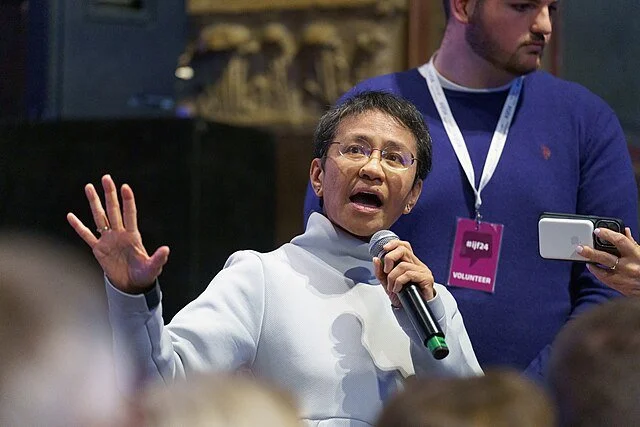
Check out this inspiring interview series by Maria Ressa, Editor of Rappler, one of the most outspoken democratic voices in the Philippines, and a Nobel Prize laureate. The series features people who fight their individual battles for truth-telling, integrity, and values.
Global Protest Tracker
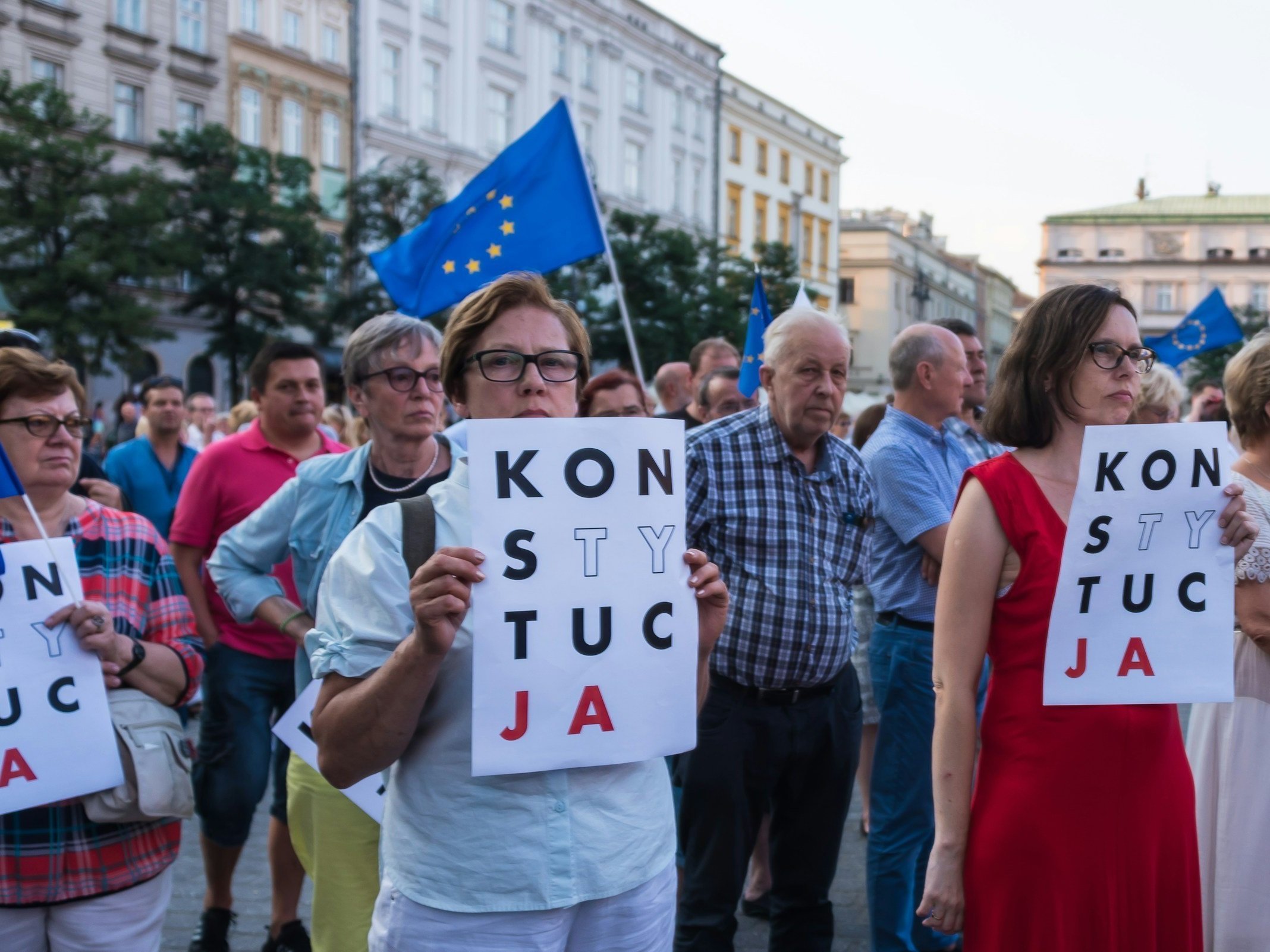
This global tracker run by the Carnegie Endowment is a useful way of getting a picture of where anti-government civil action is taking place. A short entry is provided for each protest and the search function allows you to filter by country and keyword.