
NEW RESEARCH HANDBOOK
Published: December 2026
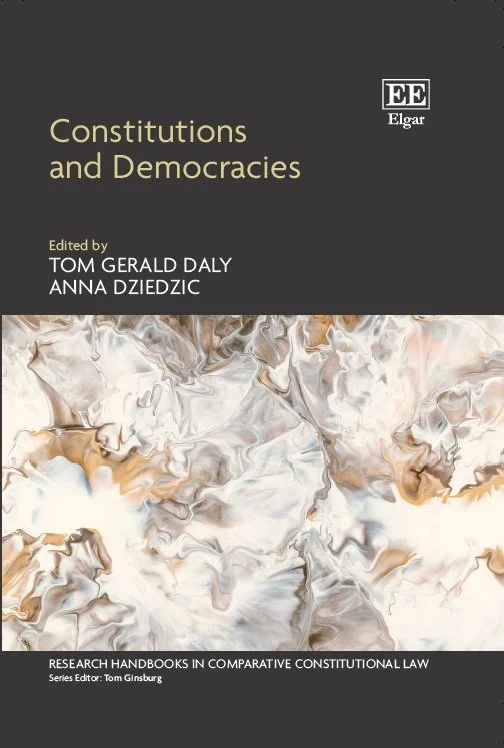
This essential Handbook interrogates the relationship between democracies and constitutions at a time of rapid global change. By examining key points of unsettlement, disruption and change, expert authors from across the multidisciplinary field of comparative constitutional studies both diagnose and respond to democracy’s challenges worldwide. Find more information, the full Handbook introduction, and a code for a 35% discount below.
“This outstanding volume brings together an exceptional group of scholars to rethink constitutional democracy for a rapidly changing world. Combining conceptual depth, methodological innovation and truly global comparative perspectives, it makes a major contribution to constitutional scholarship and will remain an indispensable reference for years to come”

The culmination of years of conversations
Demoptimism spoke with the editors, Demoptimism Director Tom Daly and Anna Dziedzic:
“This Handbook represents the culmination of years of conversations. Conversations between we two editors as colleagues and friends at Melbourne Law School; between us and the contributors to this collection; and with colleagues worldwide in both academia and practice. As such, it reflects the supportive community of comparative constitutional studies as a vibrant field of study that connects multiple disciplines. Our hope is that this collection will spark many further conversations central to the field’s development. The need for this kind of collection has only intensified since we started this project in 2023, as the world faces challenges like climate change, inequality, digital technology, multi-level governance, and purported alternatives to liberal democracy (both positive and negative).”
-
“This timely volume on Constitutions and Democracies by Tom Daly and Anna Dziedzic offers a masterly overview of the way in which law enables and structures democratic governance, valuable both for research and teaching. Moving beyond our focus on courts, they direct our attention to old and new challenges and put forward important ideas of how to build better constitutional democracies for the future.”
Michaela Hailbronner, University of Münster, Germany
“Daly and Dziedzic bring together a diverse group of scholars and practitioners who are immersed in governance issues across the globe to offer description and analysis of the pressing issues of our time. To those concerned with preserving and advancing constitutionalism in our democracies, they offer accounts and provocations that are local in specificity but global in reach.”
Dinesha Samararatne, University of Colombo, Sri Lanka“This outstanding volume brings together an exceptional group of scholars to rethink constitutional democracy for a rapidly changing world. Combining conceptual depth, methodological innovation and truly global comparative perspectives, it makes a major contribution to constitutional scholarship and will remain an indispensable reference for years to come.”
Charles M. Fombad, University of Pretoria, South Africa -
1 A new age of unsettlement and resettlement
Tom Gerald Daly and Anna Dziedzic
PART I: DISRUPTION: UNSETTLING PRACTICE, CONCEPTS & THEORY
2 Greening democratic constitutionalism
Lael K. Weis
3 Democracy, digital constitutionalism and the AI revolution
Giovanni De Gregorio
4 Constitutional transformation in Aotearoa
Annie Te One
5 Democracy, constitutionalism, and the prismatic character of parties
Mouli Banerjee
PART II: STUCTURAL CONDITIONS OF CONSTITUTIONAL DEMOCRACY
6 Revisiting constitutional endurance and democratic performance: The problem of term limits
Tom Ginsburg and Zachary Elkins
7 Gender, democracy and anti-gender constitutionalism
Ruth Rubio-Marín
8 Reassessing economic inequality: The missing link in democratic survival
Juliano Zaiden Benvindo
9 An independent public service as a constitutional necessity
Vicki C. Jackson
10 Constitutional assumptions of state capacity
Sumit Bisarya
PART III: CONSTITUTIONAL TRANSITIONS & DEMOCRATIC RESILIENCE
11 On constitutional design and democratic resilience
Rosalind Dixon and David Landau
12 Time, temporalities and constitutional design
Zim Nwokora
13 Deliberative citizen participation in processes of constitutional change
Fernanda Díaz Vidal, Nicole Curato and David M. Farrell
14 Stalled and stillborn democratic transitions: constitutional change and democratisation in Chile
Samuel I. Tschorne
15 Revolutionary coups d’état and democratic renewal
Laura-Stella Enonchong
PART IV: SCALE & MULTI-LEVEL DEMOCRACY
16 Cities, constitutions, and democracy
Ran Hirschl
17 The future of federal democracy
Gautam Bhatia
18 Small states and democracy
Abrak Saati
19 Multilateralism, multilevel governance, regional organisations and democracy
Carlos Arturo Villagrán Sandoval
20 Global constitutionalism and democracy
Takao Suami
PART V: INSTITUTIONS, CITIZENS & INNOVATION
21 Elections and the democratic governance model
Yasmin Dawood
22 Populism and the executive in the modern democratic state
Anne Twomey
23 Re-thinking Legislatures
Eneida Desiree Salgado
24 Courts and contested presidencies
D. Tinashé Hofisi
25 Re-centring citizens in constitutional democracies: deliberative referendums
Oran Doyle and Rachael Walsh
-
Tom Gerald Daly is Professor at Melbourne Law School, Convenor of the Constitution Transformation Network (CTN), Director of the Electoral Regulation Research Network (ERRN), and Director of the online knowledge platform Demoptimism (www.demoptimism.org). His comparative research, drawing on public law and political science, focuses on democratic crisis, resilience, and renewal from a global perspective.
Anna Dziedzic is Honorary Senior Fellow at Melbourne Law School, and Affiliated Expert at the Constitution Transformation Network (CTN). She was a Programme Officer at International IDEA working on Constitution Building Processes and Democracy Assessment in the Asia-Pacific region during part of the production of this book.
-
Apply discount code TDAD35 at checkout to receive a 35% discount.
-
For students and PhD researchers, this Handbook aims to provide a clear overview of the state of the field and the most prominent questions for the field. These include:
What is the relationship between constitutionalism and democracy, and how do we define these terms?
What are the tensions in that relationship, and how are they being affected by major contemporary challenges?
Can constitutional law analysis help us better understand, and respond to, challenges like climate change and AI?
How is constitutional design thinking changing as we reflect on the lessons of today and the past 4 decades of the spread and rollback of democracy worldwide?
What are some of the most important institutions for building, and upholding, democratic governance and the rule of law?
What part can citizens play in democratic governance, beyond their roles as voters or litigants?
What lessons can we learn from democratic crisis as well as democratic success?
What might a decolonial conversation between Indigenous and Settler governance systems involve?
How does the practice of democracy change with scale, from cities, federal units and small states to democracy at regional and global levels?
-
This Handbook has been compiled with practitioners in mind as well as academic researchers. You will find a wide range of analysis that illuminates the changing frameworks for applied work in constitutional law and democracy promotion, whether that involves constitutional design, legal reform, political reform, or supporting civil society and local communities.
Both Editors have extensive practitioner experience, with organisations incuding International IDEA, the UN, and the Council of Europe. Many Handbook authors also have considerable practitioner experience, or are practitioners themselves (e.g. Sumit Bisarya, Head of Constitution Building, International IDEA).
E-mail us here if you are interested in discussing how the Handbook can help your work
TASTER TEXT
Introduction: An Age of Unsettlement and Resettlement
Tom Gerald Daly & Anna Dziedzic
The Handbook contains a full introduction by Co-Editors Tom Daly and Anna Dziedzic, reflecting on how challenges such as climate change, inequality, digital technology, multi-level governance, and purported alternatives to liberal democracy require a rethinking of the established assumptions, methodologies, theories, and frameworks of comparative constitutional studies. The editors also explain how the Handbook builds on existing research by placing greater focus on non-judicial institutions and both the democratic and constitutional dimensions of governance, as well as offering agenda-setting reflections on future directions for the field. You can access the pre-print version of the text as a Demoptimism Working Paper at the link below.